Thursday, April 7, 2011

Warburgia salutaris
Warburgia salutaris (Muranga, Pepper Bark Tree, peperbasboom in Afrikaans, isiBaha in Zulu) is a species of tree in the Canellaceae family. It is found in Mozambique, South Africa, Swaziland, Malawi, Zimbabwe, and other African nations. It is threatened by habitat loss. It is a popular medicinal plant and is overharvested in the wild, another reason for its endangerment.[1]
Medicinal uses


This plant is used medicinally by the Maasai people to treat malaria.[4] It is used as a snuff or smoked for respiratory complaints such as common cold and cough.[2] The bark can be purchased at markets in Tanzania,[5] and elsewhere.[6] Extracts of the bark of the tree show antimicrobial activity.[3]

Urginea maritima
The plant Urginea maritima (syn. Scilla maritima, Urginea scilla, Drimia maritima or Urginea pancration) has the common names red squill, sea squill, sea onion, ein sit, and ada sogani. The name red squill may be reserved for a variety of the plant which has red-tinted flowers instead of the more common white. It may be placed in family Hyacinthaceae with squills of genus Scilla or included in family Liliaceae, depending on which classification system is used.
Uses
It has been used for medicinal purposes. The bulb contains cardiac glycosides which stimulate the heart and act as diuretics in moderate doses, and are emetic and poisonous in larger doses. The juice of the bulb causes blisters when put in contact with skin. The plant has been used as a rodenticide and may show promise as an insecticide. The most active compounds in the plant are scillirosides, especially proscillaridine A. In the past, it has also been used as an abortifacient. This particular use is rarely seen today as it has been shown to be dangerous and largely ineffective.

Argemone mexicana
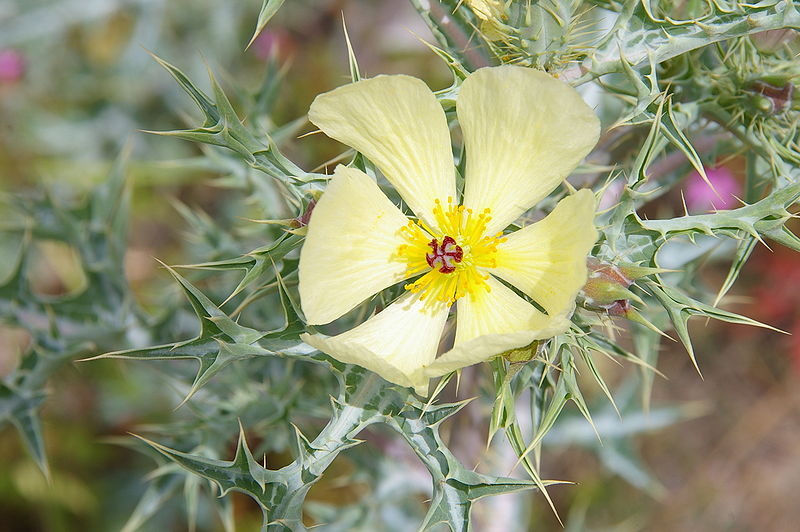
Argemone mexicana (Mexican poppy, Mexican prickly poppy, cardo or cardosanto) is a species of poppy found in Mexico and now widely naturalized in the United States, India and Ethiopia. An annual herb with bright yellow sap, it has been used by many people including those in its native area, the Natives of the western US and parts of Mexico.[1]
Medicinal uses
The Seri of Sonora, Mexico use the entire plant both fresh and dried. An infusion is made to relieve kidney pain, to help expel a torn placenta, and in general to help cleanse the body after parturition.[1]


When the Spanish arrived in Sonora they added this plant to their pharmacopia and called it cardosanto, which should not be mistranslated to blessed thistle (Cnicus benedictus). Use in Hispanic cultures includes as a sedative and analgesiac tea, including for use to help alleviate migrane headaches. The seeds are taken as a laxative.[4]

The seed-pods secrete a pale-yellow latex substance when cut open. This argemone resin contains berberine and protopine, and is used medicinally as a sedative.[citation needed]

Argemone mexicana is used by traditional healers in Mali to treat malaria.[5]

Katkar oil poisoning causes epidemic dropsy, with symptoms including extreme swelling, particularly of the legs.

Bitter orange
The name "bitter orange", also known as Seville orange, sour orange, bigarade orange, and marmalade orange, refers to a citrus tree (Citrus aurantium) and its fruit. Many varieties of bitter orange are utilized for their essential oil, which is used in perfume and as a flavoring. Bitter orange is also employed in herbal medicine as a stimulant and appetite suppressant. Slivers of the rind are used to give marmalade its characteristic bitter taste.


After the U.S. Food and Drug Administration banned the herbal stimulant ephedra, manufacturers substituted bitter orange in many herbal weight-loss products,[2] despite similar concerns about potential serious side effects and lack of effectiveness.[3][4] In a recent article by the publication Consumer Reports, it was furthermore reported that use of bitter orange may be associated with "fainting, heart-rhythm disorders, heart attack, stroke, [and] death".[5]

Uses
The extract of bitter orange (and bitter orange peel) has been used in dietary supplements as an aid to fat loss and as an appetite suppressant, although in traditional Chinese medicine it is always prescribed in concert with other support herbs, not alone. Bitter orange contains the tyramine metabolites N-methyltyramine, octopamine and synephrine,[9] substances similar to epinephrine, which acts on the α1 adrenergic receptor to constrict blood vessels and increase blood pressure and heart rate.[10][11]


Following bans on the herbal stimulant ephedra in the U.S., Canada, and elsewhere, bitter orange has been substituted into "ephedra-free" herbal weight-loss products by dietary supplement manufacturers.[2] While bitter orange has not undergone formal safety testing, it can cause the same spectrum of adverse events as ephedra.[12] Case reports have linked bitter orange supplements to strokes,[13][14] angina,[9] and ischemic colitis.[15]


The National Center for Complementary and Alternative Medicine found that "there is currently little evidence that bitter orange is safer to use than ephedra."[4] There is no evidence that bitter orange is effective in promoting weight loss.[3]


Following the presentation of a healthy young man with a myocardial infarction (heart attack), a case study and subsequent literature review found that the makers of "nutritional supplements" who replaced ephedrine with its analogs p-synephrine and/or p-octopamine from "bitter orange" had in effect simply found a loophole in the FDA's April 2004 regulation banning ephedra in those supplements by substituting a similar substance the regulation did not address, while permitting them to label the products as "ephedra-free".[16]

Drug interactions
Bitter oranges may seriously interact with drugs such as statins in a similar way to grapefruit.[17]


Tuesday, March 29, 2011

Acacia catechu
Acacia catechu also commonly called mimosa catechu, is a deciduous, thorny tree which grows up to 15 m (50 ft) in height.[2] Common names for it include Catechu, Cachou and Black Cutch. The plant is called khair[3] in Hindi, and kachu in Malay, hence Latin "Catechu" for this type species from which the extracts cutch and catechu are derived.[4] It is found in Asia, China, India and the Indian Ocean area.[1]


Through derivatives of the flavanols in its extracts, the species has lent its name to the important catechins, catechols and catecholamines of chemistry and biology.
Uses:
Food
The tree's seeds are a good source of protein.[5] It is also used as an ingredient in paan [Paan, from the word pān in Hindi: पान, is an Indian and South East Asian tradition of chewing betel leaf (Piper betle) with areca nut and slaked lime paste].
Medicinal uses
More specifically, the extract, called catechu is used to treat sore throats and diarrhoea.[2]

Abrus precatorius
Abrus precatorius, known commonly as Jequirity, Crab's Eye, Rosary Pea, John Crow Bead, Precatory bean, Indian Licorice, Akar Saga, Giddee Giddee or Jumbie Bead in Trinidad & Tobago,[1] is a slender, perennial climber that twines around trees, shrubs, and hedges. It is a legume with long, pinnate-leafleted leaves. It is also known as Gunja in Sanskrit and some Indian languages and Ratti in Hindi. The plant is best known for its seeds, which are used as beads and in percussion instruments, and which are toxic due to the presence of abrin. The plant is native to Indonesia and grows in tropical and subtropical areas of the world where it has been introduced. It has a tendency to become weedy and invasive where it has been introduced.
Uses


White varietyThe seeds of Abrus precatorius are much valued in native jewelry for their bright coloration. Most beans are black and red, suggesting a ladybug, and other colors are available. Jewelry-making with jequirity seeds is dangerous, and there have been cases of death by a finger-prick while boring the seeds for beadwork. However, it has long been a symbol of love in China, and its name in Chinese is xiang si dou (Chinese: 相思豆), or "mutual love bean". In Trinidad in the West Indies the brightly coloured seeds are strung into bracelets and worn around the wrist or ankle to ward off jumbies or evil spirits and "mal-yeux" - the evil eye. The Tamils use Abrus seeds of different colors. The red variety with black eye is the most common, but there are black, white and green varieties as well.

The Seeds of Abrus precatorius very similar in weight In Older times Indians used to measure using these seeds and the measure was called as Ratti this was used to generally measure gold and 1 Tola (11.6 Grams) = 12 Masha; 1 Masha = 8 Ratti

A tea is made from the leaves and used to treat fevers, coughs and colds.[2] In Siddha medicine the white variety is used to prepare oil that is used as an aphrodisiac.[3]

Abies balsamea
The balsam fir (Abies balsamea) is a North American fir, native to most of eastern and central Canada (Newfoundland west to central Alberta) and the northeastern United States (Minnesota east to Maine, and south in the Appalachian Mountains to West Virginia).
Growth
It is a small to medium-size evergreen tree typically 14–20 metres (46–66 ft) tall, rarely to 27 metres (89 ft) tall, with a narrow conic crown. The bark on young trees is smooth, grey, and with resin blisters (which tend to spray when ruptured), becoming rough and fissured or scaly on old trees. The leaves are flat needle-like, 15 to 30 millimetres (½–1 in) long, dark green above often with a small patch of stomata near the tip, and two white stomatal bands below, and a slightly notched tip. They are arranged spirally on the shoot, but with the leaf bases twisted to appear in two more-or-less horizontal rows. The cones are erect, 40 to 80 millimetres (1½–3 in) long, dark purple, ripening brown and disintegrating to release the winged seeds in September.
Uses
Both varieties of the species are very popular as Christmas trees, particularly in the northeastern United states. The resin is used to produce Canada balsam, and was traditionally used as a cold remedy and as a glue for glasses, optical instrument components, and for preparing permanent mounts of microscope specimens. The wood is used for paper manufacture. Balsam fir oil is an EPA approved nontoxic rodent repellent.